
 I fear that there are many Development Quality Partners (DQPs), Assessment Quality Partners (AQPs) and Qualification Development Facilitators (QDFs), not to mention the Quality Council for Trades and Occupations (QCTO) who will be angry at me for writing this. Therefore, please respond and tell me how stupid I am – if you can. The problem is that we, the learning providers, are the ones who are supposed to develop learning materials and to offer the qualifications once they have been registered. The learning materials must be aligned with the curricula and that is where the problems hit you in the face. I will not use a specific qualification as an example because it then might well be seen as an attack on a specific QDF. The QDFs that I know are great people, so I don’t want to hurt any of them.
To begin with, one will find that different people submit different evidence for prior learning should they be interested in recognition of prior learning (RPL). It is, therefore, unlikely that such candidates will have evidence that covers all the assessment criteria or learning outcomes in a qualification. That is why a holistic approach to RPL should be followed, meaning that the RPL assessor should judge against the purpose of the qualification, not rigid criteria. Specifying in the curriculum that internal assessment criteria should be used for RPL makes the process inflexible with the result that the achievement of the qualification through RPL would be extremely difficult.
Secondly, any occupational learning process follows a logical growth path, beginning with a number of exit levels outcomes to be achieved. The achievement of each exit level outcome requires knowledge, practical skills and workplace experience. One should not have any of those three elements, typically expressed as modules, standing alone. The reason for this is that competence starts with practical competence, followed by foundational competence and then, after some time has lapsed, reflexive competence. This growth path needs to be supported by relevant knowledge.
Thirdly, for some reason knowledge modules, practical skill modules and work experience modules are treated as if they are separate units of learning when each group of three should be one unit of learning. The result of this is that, what in the old unit standard-aligned qualifications constituted one unit of learning, consisting of theory, (simulated) practical and workplace practical work are now regarded as three separate units of learning. Because of this the new QCTO qualifications often contain only about a third of the learning content of the old qualifications, leading to too many credits being given to too little learning.
The ideal would be to have an equal number of exit level outcomes, knowledge modules, practical skills modules and work experience modules. It is possible to have, for example, more than one knowledge module that apply to the same skills module or work experience module, but then this should be indicated, for example by using sub-numbers. What is not acceptable is that there are knowledge modules that do not fit in with any practical or work experience module. The same applies to practical modules and work experience modules. Believe me, there are such qualifications already registered on the NQF.
Learning should follow a scaffolding or building blocks approach (they are not the same). It, however, is not possible to develop learning materials that achieve this if the logical line knowledge module – practical skill module – work experience module does not exist. Of course creative learning materials developers will “invent” their own modules, or content, to close the gaps, thereby offering more than what the curriculum requires. This, however, creates new challenges, for example that summative assessment testing knowledge or skills that are not in the curriculum.
In closing, you cannot achieve exit level outcomes without satisfying knowledge and skills requirements in a logical, systematic and complete way. If you don’t believe me, try to develop logical and well-structured learning manuals for some of the new qualifications – you will quickly stumble upon obstacles.
 Non-fiction is normally represented as fact. It is assumed that the information in such books are accurate and, hopefully, well-researched. Unfortunately writers sometimes regard their perceptions as the only truth. Everybody has the right to write a book about her pet subject, believes, militancy, fanaticism, paranoia, etc. However, a writer who claims to have done scientific research when it is clear from the contents of the book that this is not the case not only does damage to the perceptions of her readers (if they are gullible enough to believe what they read) but also to her reputation as an authority in a particular field. The following are mistakes in collecting and using data for a book that can render your book worthless and your integrity questionable.
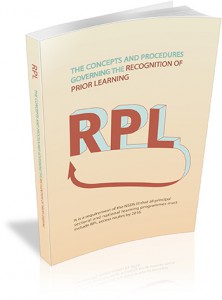 RPL should never be a complex process. There are a number of steps (we propose thirteen to fourteen steps) that can be followed in any field of learning and on any level. You should read my book entitled “The Concepts and Procedures Governing the Recognition of Prior Learning” if you wish to offer RPL in occupational and vocational learning or “A Holistic Approach to the Recognition of Prior Learning” if you are involved in RPL on higher education (academic) level.
 RPL is an important element of an articulated NQF because of its strong impact on the credit accumulation and transfer (CAT) system. This is supported by paragraph 36 of the Draft Articulation Policy which reads as follows: “Both recognition of prior learning (RPL) and credit accumulation and transfer (CAT) are enabling mechanisms for articulation and must be primary focus areas when designing the articulation apparatus and mechanisms.”
 One can probably site many obstacles in the way of an articulated NQF and not everybody will agree about which obstacles are the most important. Obviously the very fact that we have three sub-frameworks is already a problem although it can also be seen as a solution. After all, there are differences between the three sub-frameworks that call for different approaches to especially quality assurance.
 “A well-articulated system is one in which there are linkages between its different parts; there should be no silos, no dead ends. If a student completes a course at one institution and has gained certain knowledge, this must be recognized by other institutions if the knowledge gained is sufficient to allow epistemological access to programme(s) that they want to enter.” (Minister of Higher Education and Training, Dr BE Nzimande, 15 February 2013).
 In a response to a contribution on Thursday last week Sylvia Hammond mentioned a number of disruptive activities that is causing serious damage to all private learning providers, such as making use of anyone else’s training material or intellectual property without the permission of the originator, obtaining material and not paying for it, employing facilitators and not paying for their services, taking money and not providing the materials or service. This made me decide to write about something that has been bothering me for a long time already.
 Many learning institutions often resist quality assurance of education and training because of the attitude of quality assurance bodies; excessive demands on the time and funds of the universities or colleges; the perception that such bodies violate the academic autonomy and freedom of the learning institutions, fostering a compliance culture; managerial and political intrusion in academic matters as well as fear that quality assurance might damage the good reputation of the university or college. In short, role players in education and training do not trust one another.
 It is interesting to see how different countries or groups of countries adopt different strategies to ensure good quality education, training and development (ETD). Some seem to achieve remarkable success while others just don’t seem to make it, or care. Then there are those where political agendas ruin the ETD system of the country. South Africa currently faces immense obstacles of which many of you are probably aware. In this article I will suggest a strategic approach that should help us perform better. Others might be interested in my suggestions even if only to feel good about how well ETD is conducted in their countries.