Research Methods for Ph. D. Studies: Historical Research

Damaged By Bullets And Shrapnel Metal Helmet Of German Infantry Wehrmacht Soldier At World War II. Rusty Helmet Hanging On Tree Trunk.

Introduction

Historical research can be conducted with the aim of answering a wide range of social research questions.

It is a systematic process of describing; analyzing and interpreting; and comparing the past.

The past can, of course, also be compared to the present.

It is based on information from selected sources as they relate to the topic under study.

Descriptive research

When conducted with description in mind, historical research attempts to construct a map of the past.

It can also describe a developmental trajectory of events, for example an educational system, political developments, community growth or deterioration, etc.

It involves locating events in time and place and requires sensitivity towards understanding the context within which an event took place or developed over time.

Historical research used for descriptive purposes also establishes background information about events.

Trajectories of development are plotted, and it may or may not try to explain how or why events occurred.

Analytical and critical research

In analytical research, relationships between factors or events are critically interrogated within the context in which they occurred with the aim of exploring the possible causes and impact of the factors or events.

It requires critical, analytical scrutiny of documents and a process of cross-checking records and reports about incidents.

It aims to impact on decision-making and policy formulation.

When conducting historical research, you might need to search for successes or mistakes from the past in order for a society or even an individual to avoid repeating mistakes made by others and to capitalise on the successes of the more fortunate or wiser.

The process of analytical research is complicated by the fact that there is seldom just one cause of an event.

You can never be certain if you did not omit the consideration of other important factors or events.

All sources of information should, therefore, be subjected to evaluation through processes known as external and internal criticism.

External criticism refers to the authenticity of the information.

For example, is the document that you are evaluating real or fake?

Internal criticism refers to whether the information is credible.

You need to determine if the information is consistent and accurate.

Rigour and sound analytical critique of sources lend considerable validity and reliability to the findings and conclusions reached.

Inferences about intent, motive, and character are common, with the understanding of appropriateness to the context of the time period.

Comparative research

Comparative historical research is much wider in scope than other historical research designs because the units of analysis are often whole societies or systems within societies.

It implies systematic research for similarities and differences between the cases under consideration.

Comparative researchers usually base their research on secondary sources, such as policy papers, historical documents of official statistics, etc.

Some degree of interviewing and observation can also be involved.

Historical comparative researchers generally prefer first-hand accounts, written by people who witnessed something personally, rather than documents derived from other secondary sources.

These researchers need to verify two important aspects regarding documents:

The validity of the documents’ content and its authenticity.

The content of a document is valid when it is not distorted, exaggerated or false.

Validity can be checked is by making use of triangulation or any other form of corroboration.

Additional sources of information can be other, similar books, alternative documents, certification, living witnesses, demonstrations by the individual who claims authenticity, traces of validating substances, etc.

Authenticity refers to whether a document is a forgery.

Historical research can adopt paradigmatic approaches such as constructivism, critical race theory, empiricism, and post-colonialism.

Sources of data

Broadly speaking there are four types of historical evidence that you can use – primary sources, secondary sources, running records, and recollections.

Customarily, researchers rely on primary sources.

That is, the original source texts, also called archival data.

Archival data are mostly kept in museums, archives, libraries or private collections.

Emphasis is given to the written word on paper, although modern histiography can involve any medium.

Substantial historical data is already captured electronically.

The internet is already a popular source of information, even though authenticity and accuracy are difficult to confirm.

Secondary sources are the work of other researchers writing about the issue being studied.

In its widest sense, a document simply means anything that contains text.

Official reports, records from schools, hospitals and courts of law, films, photographs, reports from journals, magazines, newspapers, letters, diaries, emails, and even graffiti scrawled on a wall are all examples of documents.

Running records are documentaries maintained by organisations.

For example, minutes of meetings, records of events, commentaries about events, war diaries, etc.

Recollections include autobiographies, memoirs, and oral relay of historical information.

Summary

Historical research answers a wide range of social questions.

It can be used to describe, analyze or interpret the past.

People can learn from historical events if it is accurately and objectively communicated.

Both mistakes and successes from the past can provide lessons to learn.

Analytical research attempts to provide the basis for understanding the past by exploring past trends and applying these to current events and trends.

Analytical research is complicated by the fact that successes and mistakes are mostly attributable to many variables.

Accuracy, authenticity, and validity of data can be achieved through external and internal criticism.

Historical research makes use of four types of evidence – primary sources, secondary sources, running records, and recollections.

Continue Reading

Research Methods for Ph. D. Studies: Grounded Theory

Group therapy meeting. Happy patients embracing during support session, free space

Introduction

Grounded theory is a type of inductive thematic analysis (ITA).

It was developed by Glaser and Strauss in the 1960s.

Glaser and Strauss supported symbolic interactionism as a philosophical perspective.

How is grounded theory used?

Grounded theory uses inductive reasoning to generate the theoretical understandings of research by grounding the theory in the data that the researcher collected.

It is a highly systematic method for mostly studying social experiences, interactions and structures.

Grounded theory discovers, develops and provisionally verifies phenomena.

This means that the data originate in the framework for the study and should deliver logical and relevant conclusions.

Integrating grounded theory with other research and data collection methods

It is almost always necessary to use grounded theory in conjunction with one or more other research methods.

Any data collection method may be used in conjunction with grounded theory methods, bearing in mind that data collection should build on a naturalistic, interpretive philosophy.

Grounded theory methods specify analytical strategies, not data collection methods.

Grounded theory:

  1. Is a qualitative research approach.
  2. Requires an open mind, objectivity and ethical and responsible analysis of data.
  3. Is especially popular amongst those who study humanistic sciences.
  4. Can also be used for the study of non-human phenomena.

The purpose of grounded theory

The primary purpose of grounded theory is to generate theory from observations of real life.

Grounded theory aims at the discovery of regularities, the identification of categories or elements and the establishment of their connections.

Theoretical models and new theoretical concepts and arguments should be created and continuously revised as you collect and analyse data.

Grounded theory holds as a basic view that qualitative researchers do not go around testing an existing body of knowledge, but rather that they build new theory by allowing their data collection to steer their thoughts and conclusions into the unknown.

The grounded theory process

Grounded theory research should be done in a specific and well-defined context.

The research should be grounded in social reality and not be just an exercise in theorizing.

It uses a typical research process of data collection, data analysis, coming to conclusions, and formulating findings.

Findings should be transformable into formal theoretical models.

The process of collecting data is a prerequisite for analysis, while theory development should result from the analysis.

Researchers sometimes think that grounded theory is about the research process, especially data collection and analyses.

The essence of grounded theory, however, does not lie in the research process but rather in the attitude of the researcher towards the data and the purpose of the research.

It requires that each piece of the data is systematically compared with other data on the same or related issue or topic.

You should not ignore small units of text.

It just might have the potential to improve current theory and practice.

At the same time, you should not waste time with data that is clearly of no significance, because analysis is a time-consuming activity.

You can compare existing data with other existing data or with new data.

Grounded theory is based on the subjective experiences of humans.

You may also use your own experiences to understand the experiences of others.

Guard against just adopting the ideas, perceptions or models of others.

If you do this, you run the risk of just packaging old, existing knowledge differently.

Verification is a natural element of any scientific research because it strengthens the authenticity and validity of the findings and provides you with a measure of security.

Data collected should not be over-verified, because grounded theory epistemology leans strongly towards the generation of new theory rather than the analysis of existing theory.

Deconstruction can be used to lend a good measure of authenticity to the data.

Don’t neglect acknowledging the work of other researchers that you consulted and quoted.

Computer software

You can use dedicated computer programmes to arrange, compare and analyse the data that you collected.

ATLAS.Ti is an example of software that you can use.

There are a good number of others. I am just mentioning ATLAS.Ti because it is the one that I used and am familiar with.

You can easily find suitable software by just Googling for them.

Most dedicated computer programmes make use of coding.

Coding can be described as a sophisticated form of notecards like the ones that we used many decades ago.

You will create codes for salient data with most of the available software.

You can also write explanatory notes in the form of memorandums.

The programme groups related codes and memorandums together.

This enables you to get a clear and holistic picture of concepts and arguments so that you can more easily come to conclusions and findings.

Your findings should be or lead to new knowledge, theories and models.

From the codes and memorandums, new theory and new theoretical models can be discovered through inductive reasoning.

Inductive reasoning entails systematic data collection and analysis which leads to discovery, development and verification.

Most importantly, dedicated programmes substantially simplify the process of writing your research report.

Grounded theory methodology needs not be limited to computer analysis only.

You can, for example, still use the old notecard system or you can develop your own system on computer.

The value of grounded theory

Grounded theory enables you:

  1. To step back and critically analyse situations.
  2. To recognise the tendency towards bias.
  3. To think abstractly.
  4. Toe be flexible and open to helpful criticism.
  5. To be sensitive to the words and actions of respondents.
  6. To adopt a sense of absorption and devotion to the work process.

Utilising grounded theory for research should enable you to see beyond the ordinary and to arrive at new understandings of social life.

The most important value of grounded theory is that it enables you to generate theory and to ground that theory in data.

Paradigms that can be used with grounded theory

Any paradigmatic approach can be used with grounded theory.

Mostly, however, grounded theory displays elements of post-modernism as well as symbolic interactionism.

Post-modernism lends itself to the achievement of formal theory while symbolic interactionism implies that the study is grounded in a specific empirical world.

As already mentioned, grounded theory requires elements of interpretivism as well.

There are two versions of grounded theory, namely constructivist and objectivist grounded theory.

Objectivist grounded theory is rooted in a positivist paradigmatic approach.

The objectivist viewpoint claims that it is possible to discover objective truth.

The data already exists, and you will need to discover theory from them.

Constructivist grounded theory has its roots in an interpretivist paradigmatic approach.

The constructivist viewpoint rejects the objectivist viewpoint, contending that there is no objective truth waiting to be discovered.

Constructivist grounded theory assumes that truth exists only through interaction with the realities of the world.

Meaning is, therefore, constructed rather than discovered.

Summary

The following are the elements of grounded theory:

  1. The purpose of grounded theory is to build new theory.
  2. Current theory or observation can serve as the basis for new theory.
  3. Grounded theory deals with how data and phenomena are interpreted and used rather than how they are collected.
  4. You should systematically review units of data as they become available.
  5. Any research method should utilise the philosophy behind grounded theory, meaning that any researcher should be open-minded and objective.
  6. Building new theory requires analytical induction, meaning that new theory emerges from collected data inductively through a series of steps.
  7. Grounded theory requires the development of five interrelated properties.
    1. The theory must closely fit the relevant field of study in which the new theory will be used.
    1. The new theory must be readily understandable to laymen concerned with the field of study.
    1. The new theory must be relevant to a multitude of diverse daily situations within the focus area of the field of study.
    1. New knowledge should be generalizable as widely as possible.
    1. The new knowledge must allow those who use it to have enough trust in the validity and accuracy of the new knowledge, theories and models.
  8. Dedicated computer programmes enable you to discover regularities in data, to identify categories or elements and to establish their connections.
Continue Reading

COVID-19 Moves us to Focus More on Online Learning

Mentornet is probably the only private learning institution offering nine legacy national qualifications accredited by the ETDP SETA and six occupational qualifications accredited by the QCTO.

We do not know how or when the crisis with the COVID-19 virus will be resolved. Until that happens, we urge you to rather enroll for online learning. You can always switch back to contact learning once the current crisis is over. In that manner at least you will not need to interrupt your studies.

You can obtain more information about the qualifications on our website (www.mentornet.co.za).

The qualifications for which we are accredited are listed below.

Qualifications for which Mentornet is accredited as on 3 March 2020

  1. Legacy qualifications for which Mentornet is accredited by the ETDP SETA:
  Qualification
1 Qualification ID 23095: Higher Education and Training Certificate: Development Practice: Level 5
2 Qualification 50331: National Certificate: Occupationally Directed Education, Training and Development Practices: Level 6
3 Qualification 50332: FET Certificate: Occupationally Directed Education, Training and Development Practices: Level 4
4 Qualification 50333: National Diploma: Occupationally Directed Education, Training and Development Practices: Level 5
5 Qualification 50334: National Certificate: Occupationally Directed Education, Training and Development Practices: Level 5
6 Qualification 57428: FET Certificate: Youth Development: Level 4
7 Qualification 58761: FET Certificate: Early Childhood Development: Level 4
8 Qualification 67509: FET Certificate: Community Development, Level 4
  • New occupational qualifications for which Mentornet is accredited by the QCTO:
  Qualification
9 97708: Occupational Certificate: Community Development Worker: Level 4
10 97691: Occupational Certificate: Community Development Practitioner: Level 5
11 97154: Occupational Certificate: Occupational Trainer: Level 4
12 97542: Occupational Certificate: Early Childhood Development Practitioner: Level 4
13 94598: Occupational Certificate: Library Assistant: Level 5
14 96372: Occupational Certificate: Career Development Information Officer: Level 5
15 101321: Occupational Certificate: Learning and Development Practitioner: Level 5

Sincerely yours

(Dr. J.P. Nel)

CEO Mentornet

Continue Reading

Research Methods for Ph. D. Studies: Field Research

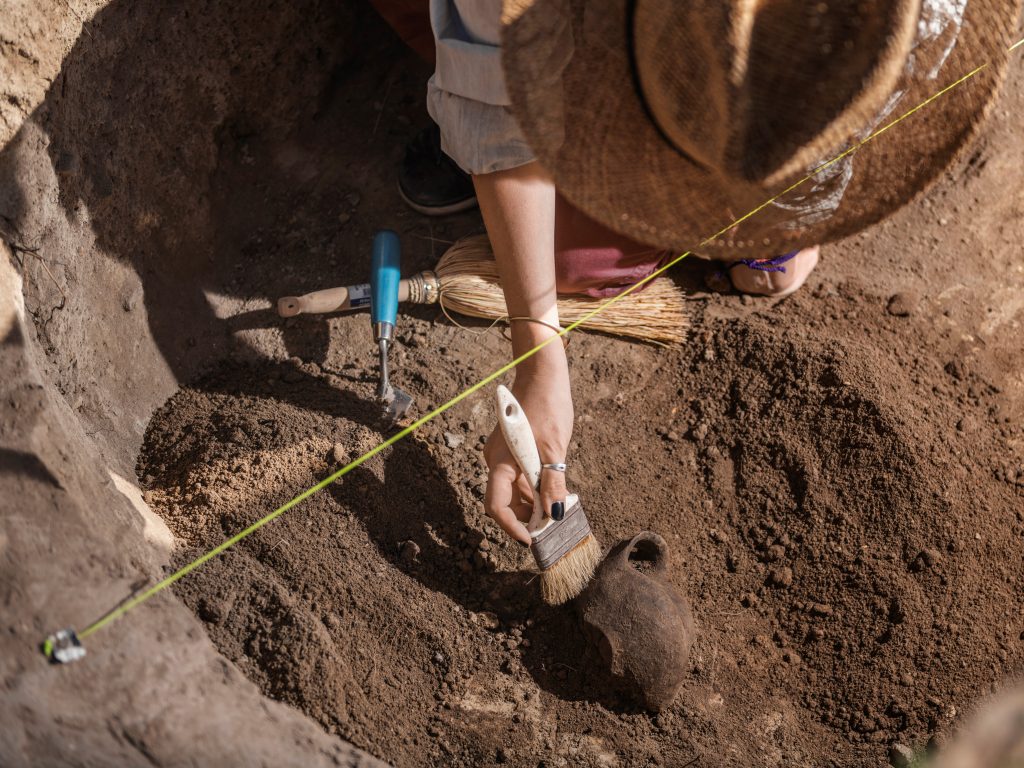
Female archaeologist digging up ancient pottery object at an archaeological site.

Introduction

Once when I sent out questionnaires for a research project, the CEO of a manufacturing plant collected and worked through the questionnaires completed by his employees.

There were probably 100 to 200 completed questionnaires. He removed all the questionnaires that he felt could put him in a bad spot and sent me the rest.

Of course, I did not use any of them.

I was fortunate that one of his employees phoned and told me what he did.

Field Research

For many researchers, the collection of data involves or at least includes fieldwork.

Not all field research deals with people.

Also, fieldwork is not limited to research in nature only.

Field research can require the use of quantitative or qualitative analysis.

Preparing for field research

You should first refine your research project and develop your data collection instruments before you embark on fieldwork.

This is because your topic and the context in which your research will be done will determine if you should do fieldwork or not.

Where field research will take place

Field research, or fieldwork, means conducting empirical research in real-world settings.

You can do fieldwork in a classroom, observing students or lecturers, in factories, on ships, in aircraft and many more.

Doing fieldwork is not a must for all research.

You will use fieldwork if your research topic demands it, if you feel that it will enable you to do accurate and valid research, if your study leader expects it from you, if you can afford it, and if it is something that you will enjoy doing.

The research process

In the spirit of grounded theory, you should be open-minded about the realities that you encounter.

Let the data that you collect lead your thinking processes.

Don’t try to bend what you see and experience to fit your preconceived ideas.

Preconceptions that you should get rid of include personal beliefs and initial theoretical propositions.

It might be necessary to divide your observations into different categories.

Don’t categorise your observations and events prematurely, though.

The first days in the field are often seen as the most challenging and emotionally rewarding.

Meeting a new group of people in their environment, about which you might not know much, can be uncomfortable, perhaps even intimidating.

Remember that such people might not trust you in the beginning.

People are suspicious of the unknown and they may resist you and your research in the beginning.

Your research will be as strange to them as their environment to you.

If your doctoral studies are an extension of your previous studies, you might feel more comfortable with the environment in which you will do research.

Even so, you will probably encounter some new experiences and observations.

Doing site visits is a formally recognised way of doing fieldwork.

Site visits can be the only data collection method that you may use.

However, it is mostly necessary to collect other data as well.

You should be able to develop categories, propositions and eventually meaning based on what your experience and observe in the field.

Participant observation takes place during a site visit and a site visit may include other data collection activities.

Can you see how you can integrate different research methods?

Experimental methods, for example, can fit in well with fieldwork.

An advantage of site visits is that they enable data to be collected from many field settings as part of the same study.

The data from any single setting or site may be limited in terms of quantity, quality, and variety.

Studying cross-site patterns might be necessary for comparison, to identify trends or patterns in phenomena or behavior and for corroboration of data.

Not just any field setting will be suitable for research and data collection.

Difference In functions, context, time and size can render some sites irrelevant to your research topic.

It might sometimes be necessary to visit the same site at different times.

An example of this is where you do research on the effect over time of global warming on glaciers, rivers, vegetation, etc.

Site visits are likely to be more rigid than participant observation.

Site visits usually follow a pre-established schedule, as well as an agenda while you are in the field.

Site visits can be time-consuming and require substantial preparation.

It can also require good timing, for example, if you were to do research on the migration of salmon up rivers to spawn.

Interviewing, conversing with participants, and observing them while they do something that you do research on will also require good planning and timing.

Members of a field setting for interviewing may have helped you to arrange the schedule.

They will probably use the opportunity to schedule the interviews so that it will suit them.

The disadvantage of this is that they can also prepare their responses to your questions in advance, thereby making it artificial and probably not valid.

Their responses may be idealized and what they think you would like to hear.

This is an example of reflexivity.

Reflexivity in this context means that the presence of the researcher affects the people being studied.

The same kind of situation can happen in the case of participant observation.

A further complication arises when you are accompanied by your host during the site visit.

The host may wish to monitor you and see and hear what you learn from his employees.  

Paradigmatic approaches that fit well with field research include behaviorism, constructivist, critical race theory, critical theory, functionalism, neoliberalism, positivism, pragmatism, radicalism, and scientism.

Summary

Field research can deal with people, phenomena in nature or even history.

It may require qualitative and/or quantitative research.

You will need to do literature study and decide how you will collect further data first before you will know what kind of field research you should do.

Fieldwork can be done almost anywhere.

You need to be open-minded and objective about the data that you collect through fieldwork.

Also, be prepared to go through a process of mental adjustment. You will need time to grow accustomed to strange people and an unknown environment.

The contextual conditions between participant observation and interviewing are not the same, but both can be damaged by reflexivity.

You can integrate fieldwork with most other research methods.

Fieldwork is not always necessary for all research on doctoral level.

Continue Reading

Research Methods for Ph. D. Studies: Ethnography

Young Indian woman wearing traditional sari dress with beautiful embroidery and set of jewelry for a wedding

Written by Dr. Hannes Nel

Introduction

Why would academics do research about people that they probably regard as inferior?

In a positive vain probably because they want to help those who are less fortunate than them.

Did the researchers ask the people if they needed or wanted help?

I would think yes, at least most of the time.

And if the researchers try to help, will they do the right thing?

Unfortunately, not always.

I think it can be humiliating and frustrating to have outsiders dissect your value system and the way you have lived for centuries.

And then they tell you how you should live and what you should do.

Remember, these people know their culture and way of life and they are watching you while you observe them.

Sometimes it can be funny, but it can also be embarrassing and lead to serious damage and harm to both the people being researched and the researcher.

It is not easy for an outsider to understand the culture and being of another population group.

People with a populist orientation will probably feel that such differences are not important and that it should be eliminated.

That, however, is not the reality for many nations.

For an outsider ethnography as a research method is much more difficult than we think. That is also why there are so many researchers who made fools of themselves when they tried to tell the world how people from other cultures think, live and do things.

What is ethnography

Some may regard ethnography and ethnomethodology as the same thing.

They are not entirely wrong.

One can argue that ethnomethodology is the philosophy behind ethnic research.

In my mind ethnomethodology:

  • claims that research deals with everyday life amongst people in a social setting;
  • where currently observed behavior and interaction provides the most accurate and valid data.

For the purposes of this post, ethnomethodology is a paradigm that can be used with ethnography, which is a research method.

Ethnography, therefore, is the method by which ethnic research is conducted.

I will discuss ethnomethodology as a paradigm in a future post.

How did ethnography begin?

Ethnography mostly has colonialism as its foundation.

It relates to distant cultures that were occupied by the seafaring nations, largely between the fifteenth and seventeenth centuries.

Colonialism came to an end in the nineteenth and twentieth centuries.

The influence of colonization can still be seen in what used to be colonies and is popular as a topic of research.

Unfortunately, some researchers call any kind of quantitative research ethnography.

Ethnography has traditionally been associated with social and cultural anthropology.

Sources consulted in ethnography

Ethnographic research sometimes needs to be done through semi-structured interviews or literature study that will include official documents.

This can include historical data and not just current observations.

The process of ethnographic study

Ethnography encompasses forms of research that are extremely diverse from a methodological point of view.

Ethnography can have a contemporary or historical focus.

It is the aim of ethnography to establish the hidden inferences that distinguish, for example, different handshakes in a given culture.

Such a phenomenon is then placed in its social and cultural context.

Ethnography, therefore, is oriented toward studying shared meanings and practices, or culture.

As a researcher, you might need to study a community for a long period, perhaps years to gain some understanding of their culture and value system.

Although ethnography is traditionally associated with long-term fieldwork, some aspects are employed in applied settings.

Applied, or current settings require a naturalistic research approach.

Observing individual and group behavior in its natural context and participating in that context can generate insights that might otherwise have eluded you.

Ethnography follows a holistic perspective, based on the premise that human behavior and culture are complicated phenomena and are composed of, and influenced by, a multitude of factors.

These might include historical precedents, the physical context in which people live and work, the social structures in which individuals are embedded and the symbolic environment in which they act.

Ethnography assumes that all human behavior is intentional and observable.

Research should, therefore, be oriented towards understanding the reasoning behind people’s actions.

This means that you, as the researcher, and often not a member of the community, will probably spend time living in the community observing and doing in-depth interviews, reading and researching primary source material and observing the lives of the people that you wish to study.

Eventually, you will compile all this data and analysis to create a full picture of the group you are studying.

The picture includes not only reporting what people do or say but also some analysis that tells us about the social structure and worldview of the community.

You should not disrupt the environment or routine of the target for your research.

This means that you, as the researcher, might need to be “invisible” and involve yourself in unobtrusive observation.

In this instance, an etic approach will probably be more effective than an emic approach.

You will need to establish trust and rapport between you and those whom you do research on.

Also, you should guard against becoming emotionally involved with the target group for your research because it might cloud your judgement.

Research reports are in the form of a narrative, with key evidence, such as detailed descriptions of episodes, being reproduced to illustrate your findings and recommendations.

Paradigmatic approaches that fit well with ethnography include relativism, behaviorism, constructivism, critical race theory, critical theory, ethnomethodology, and post-colonialism.

Summary

Ethnography literary means “to write about a group of people”.

Traditionally, ethnography implied research by an individual.

Modern ethnography also allows for teamwork.

Research topics and problem statements or questions require the study of social and cultural processes and shared meanings within a group of people.

Participant observation is the method most used in ethnographic research.

Normally ethnographers will spend lots of time in the field to study the lives of people from within their naturalistic setting.

The “thick” detail of the data that you can obtain through participant observation usually fulfills the key criterion of validity far better than data obtained by other methods.

Ethnographic research can also consult data sources such as interviews and literature study.

It also offers flexibility and can provide the basis for inductively generating new theoretical explanations.

Ethnographic research can:

  • follow a qualitative or quantitative approach,
  • will probably follow an emic approach, although an etic approach would also be possible, and
  • can be done by one or a group of researchers.
Continue Reading

Research Methods for Ph. D. Studies: Conceptual Studies

University Students Attending Lecture On Campus

Introduction

Is prostitution all bad?

Are all prostitutes bad people?

When is a person a prostitute?

In laymen’s terms, one would probably call subjective answers to questions like these “labeling the individual”.

The label can easily become a concept for academic research.

Concepts are the elements of which theories are composed.

Also, concepts are symbolic and abstract elements that represent objects, or features of objects, processes, or phenomena.

If prostitution is the topic of your research, you might need to identify characteristics that will define such a person.

Concepts may introduce new ideas or perspectives.

They may also be a means of explaining a broad generalization.

You might, for example, discover through your studies that prostitutes are not all bad, which might question the rather general perception that a prostitute can only be defined in terms of bad characteristics.

In terms of ideas, concepts are important because they are the foundation of communication and thought.

Concepts provide a means for people to let others know what they are thinking and allow information to be shared.

By conceptualizing a set of behaviours or ideas as part of a coherent package, we can describe a range of possible ideas, relations, and outcomes with a single term.

Examples of such terms are sociopaths, delinquents, criminals, rapists, altruists, serial murderers, etc.

Conceptual studies are largely based on secondary sources that you, as a researcher, may consult to gain an understanding of concepts.

They aim to add to your existing knowledge and understanding.

An in-depth critical analysis of the literature is intrinsic to concept analysis.

Apart from books and documents, maps and air photos can also be sources of data for concept analysis.

Conceptual cartography takes the process of critical analysis further because maps are both analytical tools and products of concept analysis.

Conceptual studies can comfortably use the interpretivist paradigms, for example ethnomethodology, hermeneutics, interpretivism.

Critical paradigms, for example feminism, can also be used.  

The classical concepts analysis-type studies follow a step-by-step procedure.

The following are possible steps:

Step 1: Select the concept.

The concept may be prostitutes, whom you would describe in terms of certain characteristics.

Step 2: Identify the purpose of the analysis.

The purpose of your analysis might, for example be to determine real and objective characteristics of what defines a person as a prostitute.

Step 3: Analyse the concept’s range of meanings.

You will need to keep an open mind when doing research through conceptual studies.

Kill your preconceived perceptions.

Let your research discover the range of meanings for you.

Step 4: Determine the critical attributes of the concept.

Critical attributes can also be subjective if you don’t wipe out your perceptions and believe the data that you collected.

You will need to consult unbiased sources of information. Don’t interview just the reverent at a church – also speak to the prostitute.

Step 5: Select a paradigmatic approach.

Interpretivist paradigms are mostly best for conceptual studies because they accept conversation and personal opinions as data.

Step 6: Construct additional cases.

I’ve come across two researchers who did research on just one prostitute each. This can be acceptable, depending on the purpose of your research.

However, corroboration can be found best by comparing case studies and consulting a variety of data sources.

Step 7: Identify antecedents and consequences.

Real-life experiences can often be the best evidence in social research.

Even natural scientists look for actual cause and effect occurrences in their research.

Summary

Conceptual studies:

  1. Tend to be abstract, philosophical and rich in theoretical underpinnings.
  2. Is the foundation of communication and thought.
  3. Is largely based on secondary sources of data.
  4. Follows a step-by-step research procedure.

Concepts are the building blocks from which theories are constructed.

They can also be the symbolic and abstract elements of theories.

Conceptual studies aim to:

  1. Add to existing knowledge and understanding.
  2. Introduce new ideas and perspectives.
  3. Explain broad generalisations.
  4. Describe a range of ideas in a single term.
Continue Reading

Research Methods for Ph. D. Studies: Case Study Research

Green plants and scientific equipment in biology laborotary

Written and posted by Dr Hannes Nel

Introduction

There is an increasing number of COVID-19 cases across the world without a defined chain of transmission.

It is easy to miss infected people who came into contact with the virus.

New cases increasingly crop up in unsuspected places.

There is still much uncertainty regarding how the virus spreads.

Rumours abound, and scaremongering is becoming as serious a problem as the virus itself.

This is a perfect example of a problem that can be researched through case study research.

I will discuss case study research as a research method in this article.

Case study research

Case study research can follow almost any research paradigm.

The exceptions can be technicist paradigms, especially scientism, rationalism, positivism and modernism.

Then again, I believe one can even use case studies to do research in natural science.

Case study means doing systematic research on contemporary phenomena or events.

Like action research, it is linked to a specific time, site and context.

Multiple sources of evidence can be used.

A case study strives towards a holistic and comprehensive understanding of how participants relate to and interact with each other in a specific situation.

Case study research looks for meaning in a situation or event.

It can be used across a variety of disciplines to answer epistemological questions.

Research questions can be answered by an individual, two people or a whole group.

Although answers are given by members of a target group, the focus is on a system of action rather than just the sample for the research.

Case study research can be selective, focusing on one or two issues that are fundamental to understanding the system being examined.

Case study research investigates behavior, but not just the behavior of the target group for the research.

It strives to identify the behavior of an entire system.

For example, the researcher might do research on how people react to those who might have come into contact with the COVID-19 virus by interviewing them.

Or they can determine how people respond to such “almost infected” people by observing how family and friends react when they return home from where they could have come into contact with the virus.

The researcher will probably try to identify a pattern of behavior that can be regarded as generally applicable.

You will need to come to a deeper understanding of the dynamics of the situation before a behavioural pattern can be identified and described.

A strong point of the case study method is that almost any data collection method can be used.

For example, participant observation, interviewing, audio-visual material, document surveys and even the collection of physical artifacts.

You should determine in advance what evidence to gather and what analysis techniques to use with the data that you collect.

Data collection will probably be mostly qualitative in nature, but it can also include quantitative data.

A second strong point of the case study method is that it deals directly with the individual case in its actual context.

Case studies get as close to the subject of interest as they possibly can.

This is achieved because direct observation in natural settings can be used.

Also, because you can have access to subjective factors, such as thoughts, feelings, desires, etc.

Surely you will ask people how they feel, how they experience the situation, etc. when you interview them.

The case itself is the focus of your research, not the variables.

You need to focus strongly on the purpose of your research, nothing else.

The general purpose of case study research is to generate knowledge.

It can also be used for theoretical elaboration or analytical generalization.

Criticism of case study research is that it often depends on a single case.

That makes it difficult to have your findings apply generally.

Summary

Case study research is perfectly suited to finding solutions for social problems.

The current COVID-19 situation is a good example, where social scientists would investigate the psychological effect of the threat on people while natural scientists try to find a way in which to combat the virus.

Case study research can use most philosophical stances or paradigms.

Epistemological questions are mostly investigated.

A good measure of generalization is sought for human behavior at a particular time and context.

You, as the researcher, will need to come to a deeper understanding of the dynamics of the situation before a behavioral pattern can be identified and described.

Case studies investigate a target group through direct observation in a natural setting.

The purpose of the research is critically important.

Case study research can be used to generate knowledge, for theoretical elaboration and analytical generalization.

Continue Reading

Research Methods for Ph. D. Studies: Action Research

Introduction

Some universities charge exorbitant fees for the privilege to study through them.

And some parents will pay what the university charges because they want their children to obtain a Ph. D. from this and that excellent university.

It is also true that some universities are better positioned to offer research in certain fields of science.

You might need a laboratory that only one or a few universities have.

Or perhaps you might need a special computer or other scientific tools and equipment that not all universities have.

In such an instance you will be doing the right thing to do whatever it takes to be accepted for Ph. D. studies by the university of your choice.

However, whatever the topic of your research, the most important deciding factor if your Ph. D. will be a quality product is you – the student.

I will discuss action research as a research method in this post.

Action research

Some know action research by other names, for example, action learning, action science, collaborative inquiry, community-based study, contextual action research, co-operative inquiry, emancipatory research, participatory research, etc.

Action research is “learning by doing”.

This means that a group of people will identify an immediate problem, do something to resolve it, evaluate their efforts and try again if unsuccessful.

Action research aims to solve the practical concerns of people in an immediate problematic situation.

It, simultaneously, adds value to social science.

The community that is the target for action research often also actively participate in the research.

This means that the people affected by a social problem work with the researcher to study a problem.

They help to collect data, make suggestions and recommendations and use the results of the research to influence social change.

This would be an emic approach to research.

Just to clarify – In terms of the relationship between the researcher and his or her target for research, we can follow either an emic or an etic approach.  

An emic approach to research is where the researcher and the target for the research cooperate in finding a solution to a problem.

An etic approach to research would be where the researcher does research as an observer divorced from the target group.

Action research is a developmental research process.

This means that people not only solve problems by falling back on their current knowledge but also learn and develop new knowledge that they can apply in the future to solve the same or similar problems.

The solutions to problems in one community can often also be used to solve the same or similar problems in other communities.

Action research is typically cyclical in terms of data collection and analysis and starts with identifying a problem, collecting data, analyzing the data, taking action to resolve the problem and evaluating the outcome of the research.

Typically, the participants in the research “own” the problem and they become partners in carrying out the research.

A process of reflective critique is followed, meaning that members of the target group together with the researcher would consider, discuss and decide on a solution to the problem being researched.

It also implies dialectical critique, meaning that the research problem is solved through open critique.

As a researcher you will probably be concerned that people might not accept your interpretations, ideas and judgements.

This is normal. People often resist change because it creates uncertainty and sometimes even fear.

Sometimes fear has little to do with the potential changes in the immediate environment, but rather with the research process itself.

There is also the risk that change might threaten people’s status and even their relevance to the community.

You will need to address these fears if you are to gain and keep the support of the community with your research.

Such fear is not all bad, though. It is what drives you to do professional research.

The nature of action research raises several possible ethical dilemmas.

Your bias towards the data being collected might damage the quality of your research as well as your relationship with the target group for your research.

Other factors, such as the needs and fears of the target group might contaminate the authenticity and validity of the data that you and the members of the target group collect.

The target group might have a different agenda than you for participating in the research.

Your own diligence and drive, or rather lack of diligence and drive, can hamper the level of your involvement in the research.

You might become too emotionally involved with the target group for the research and the problem being investigated.

The effect on the participants when you withdraw from the community on completion of the research might leave them in a position where they cannot manage the situation on their own.

You will need to consider this and ensure that the community is not damaged by your research.

Examples of paradigms that fit in well with action research are:

Ethnomethodology.

Neoliberalism.

Summary

Action research considers theory to inform practice, that is the real situation in a particular context and at a particular point in time.

Theory together with reality is analysed to transform the status quo, that is to solve a social problem.

Solving a social problem is achieved by following an emic approach and reflective and dialectical critique.

The researcher should consider the possible risk that research can do more harm than good if there is not mutual respect and trust between the researcher and the community whose problem is being addressed.

Continue Reading

Research Methods for Ph. D. Studies

Introduction

For my first doctoral study, I used a quantitative method, specifically  CHAID supported with loglinear analysis and the CATMOD procedure. I chose this statistical method because I intended to send out many questionnaires. I had to ask for the assistance of the statisticians of the South African Council for Social Research to process my completed questionnaires because I did not have the software or knowledge to do the work.

Of course, I had to analyse the printouts of the processed data myself, else I would not have been able to come to any conclusions, findings or suggested solutions to my research problem.

In retrospect, I was walking on thin ice by making use of a statistical process about which I knew absolutely nothing.

In this article, I will share with you an introduction to research methods.

Most of the methods that I will discuss should be used with qualitative research, although some can also be used with quantitative research.

All research methods can be used with a mixed approach.

The challenge with quantitative research methods is that they are often dedicated to a specific scientific field of study rather than to a research method.

They often also deviate from the generally accepted structure of a Ph. D. Research Report.

Therefore, I will only share a few remarks on statistical research methods in general rather than to try to discuss research methods that are used in a specific natural science field.

Research methods overlap with research paradigms and data collection methods. I will discuss them separately in future posts.

Mixed research methods

Research on doctoral level is becoming increasingly diverse and inclusive of both qualitative and quantitative research methods.

That is one of the reasons why a mixed-method approach is often followed.

Another reason why students decide to follow a mixed-method approach is because they feel that a combination provides a better understanding of a research problem than just focusing on qualitative or quantitative research methods.

Some students argue that a mixed-method enhances the validity and accuracy of data and the relevance and value of research findings.

The overarching premise is that the integration of two or more methods should facilitate the achievement of research objectives.

The decision of whether to integrate multiple methods depends on a combination of the research objectives, the resources and time available, your philosophical assumptions, your knowledge of research methods and your style or personal preferences. The people who will read your research report, especially your sponsor, but also your study leader and the external examiners, will also have an influence on which research method or methods you will use.

Different methods can be used as a form of triangulation in the hope that the findings from the different methods will corroborate one another.

Where will you discuss the research method that you will use?

You will probably discuss the research method that you will use in the second chapter of your dissertation or thesis.

You should explain:

  1. The method that you will use without trying to “teach” you study leader or other readers the intricacies of research. They probably know more about this than you.
  2. Why you chose the method.
  3. The reason why you chose the method.

You should also provide a detailed description of the components of the methodology of your choice.

The method that you choose must enable you to progress from a problem situation to a solution.

As far as possible you should do as much of the work as possible on your own.

For my second doctoral study, I used Atlas.Ti to code an analyse the data that I collected, mostly through interviewing. I used grounded theory, which is a qualitative research method. This time around I attended a short course on Atlas.Ti at the University of Guildford in Surrey before embarking on my studies, so that I could do all the work on my own.

Your method or methods can consist of a combination of literature study, models, arguments, mathematical proofs, surveys, case studies, experimentation, etc.

Did you notice that I am integrating research methods with data collection methods here?

The chapter on your research methods is mostly not difficult to write.

After all, you will have all the information from a book or books that you consulted.

Even better, your study leader can suggest a method that will work well with the nature of your research.

In addition to the purpose of your research, you should also consider your knowledge, experience, strong points, and weak points and the data that you will have access to.

Don’t choose a quantitative method if you feel uncomfortable with calculations and statistics or if you do not have access to laboratories or other scientific equipment that you will need.

Don’t choose a qualitative method if you will not have access to or feel comfortable with people as your target group.

Summary

You will probably use quantitative research methods if you feel comfortable with figures and statistics, if you have access to the laboratories or other scientific equipment that you will need for your research and if the topic of your research is such that it can be investigated quantitatively.

You will probably use qualitative research methods if you feel comfortable when working with people, when the topic of your research is suitable for qualitative research if you need to solve immediate social or community problems.

You will probably use mixed research methods if there is a need to collect and analyse quantitative and qualitative data.

You can use more than one research method, and some of them might be quantitative while others are qualitative in nature. Different methods can be used as a form of triangulation, which should give you a measure of corroboration of your data and findings.

Keep in mind that research methods, paradigms, data collection methods, and data analysis methods are all parts of the research process.

You will probably discuss the research method that you will follow in the second chapter of your research report. Although it is an important chapter, you should not go into too much detail.

Continue Reading

The Interrelatedness of Ontology, Epistemology, and Methodology

Introduction

In this article I discuss epistemology, ontology and methodology as a unit. They belong together as elements of academic research.

Ontology

Ontology is concerned with the natural world.

It is the nature of reality.

It focuses on the core characteristics, origin and what we can observe.

The “what” question often leads to an ontology.

For example: “What exists?” “What is true?” “What is real?” “What is?”

Ontology deals with the nature of being. Such “being” is not necessarily checked for validity, although scientists often try.

You can already identify an event or phenomenon as true by making use of your senses.

The “origin of” or “original meaning of” is given by ontology.

Phenomena are not explained but rather described or simply stated as fact.

Epistemology

Epistemology is the study and explanation of what knowledge is and the logic behind the knowledge.

It can also be the philosophy behind knowledge.

It focuses on explaining knowledge, how we can obtain knowledge and how we should reason about the nature and elements of knowledge.

Knowledge is often formulated and explained in terms of how an event or phenomenon looks, why it is as it is, how models interact (in a systematic or erratic manner).

Epistemology is made up of the elements of the world in which we live.

Three such elements are popularly described.

  1. The first element is a philosophical analysis of the nature of knowledge, which can include arguments, opinions and beliefs and how it relates to concepts such as the truth, validity, relevance and justification.
  2. The second includes various issues of scepticism. It asks if knowledge, arguments, opinions and beliefs are true, valid, relevant and justified.
  3. The third is an explanation of the sources, criteria and scope of knowledge, arguments, opinions and beliefs.

For an epistemology understanding is more important than knowing and knowing is more important than to believe.

Even so, you can hardly develop an epistemology if you do not “know”.

You will at least have an opinion or belief.

The epistemology of an event or phenomenon can be found through quantitative or qualitative research methods.

Your epistemological approach should be an effort to generate descriptions and explanations of the world, or at least the small part of the world that you do research on.

Your descriptions and explanations must, of course, be true, valid, relevant and justified.

Epistemology seeks to understand the how, origin, processes and limitations of observation.

Developing an epistemology requires operations such as drawing distinctions, establishing relations and creating constructs.

Epistemology includes a description of how knowledge impacts the target group for your research.

So, you can see that epistemology includes the research methods, data collection methods, and data analysis methods that we employ in our research.

Epistemology is the investigation of what distinguishes justified belief from opinion.

It implies the provision of evidence for your conclusions and inferences.

Methodology

Methodology is the procedure that you will follow to identify and prove your argument, opinion or belief.

Some researchers differentiate between research methodology and research methods.

They argue that research methodologies are philosophical approaches while research methods are ways of doing things.

Philosophical approaches are also called paradigmatic approaches while research methods can include data collection methods.

I am just mentioning this for the sake of those who wish to differentiate between research methodologies and research methods.

Whatever stance you adopt will probably not influence the research work that you do.

Methodology is concerned with how you know something and go about obtaining the knowledge and understand that you need to solve a research problem.

It is the way in which you would discover knowledge in a systematic manner.

The link between ontology, epistemology and methodology

Ontology defines your research framework while epistemology determines the research questions that you will need to answer.

Together, ontology, epistemology and methodology form an all-encompassing system of interrelated practice and thinking that defines the nature of your research.

This is called your research premise, paradigm or interpretive framework.

Checking for validity is the bridge between ontology and epistemology.

If you manage to explain a fact, you will have crossed the bridge to epistemology.

Here is a simple example – your ontology can be that something tastes sweet. Your epistemology will be the reason why it tastes sweet.

A century ago, most people would not have known what a computer is. They never saw one and, therefore, it is not included in their ontology.

Today almost all people will recognize a computer when they see one, but some will still not know how it works. It has not been explained to them and, therefore, it is not yet part of their epistemology.

Epistemology and methodology are driven by ontological beliefs and observations.

Ontology is the belief upon what you base your research. It specifies the nature of something that we can sense and that we wish to investigate further if we are to know more about and understand an event or phenomenon.

Epistemology is the philosophy and knowledge behind the belief that you will investigate by making use of a research method, or methodology.

Summary

Ontology is “the science of being”.

The ontology is a statement of fact without explanation.

Thinking, evaluating, studying and theorizing about an event or phenomenon within the framework of a predefined society can be your epistemology.

Epistemology asks: “how do we come to know?”

Epistemology is explanation, not a label.

In doctoral research you need to find evidence that your theoretical and philosophical claims are correct.

Epistemology is the theory of knowledge and the science of explanation.

Methodology is driven by your ontological beliefs and based on your initial epistemological philosophy. Your initial epistemology is improved through the development of new knowledge and philosophy.

Continue Reading